You have your three targets, a baseline and a plan taking shape. Grace Papers helps you find what is driving each one, build the capability that moves it, and measure whether it is working.
Trusted by leading organisations to turn gender equality ambition into measurable outcomes.
WGEA Targets timeline
What the next three years look like
The requirements apply to designated relevant employers that directly employ 500 or more employees in Australia; smaller employers can use the same framework voluntarily. The final assessment compares your end-of-cycle result with your baseline, so what matters is a trend that holds. For action targets, what counts depends on the target: the required policy, entitlement, consultation, analysis or reporting elements have to be evidenced, and some targets allow demonstrated improvement through partial completion.
Baseline2024–25
The data every result is measured against. Private sector uses the 2024–25 reporting period; Commonwealth public sector uses 2024.
Selected2026
Three targets from a menu of 19, at least one numeric. Once lodged they cannot be changed, and they are published on the Data Explorer.
ReportedAnnually
Progress reported each year in your Executive Summary, which your CEO is required to give to the governing body.
AssessedEnd of cycle
Result compared to baseline. Employers who do not meet or demonstrate improvement may be named, and ineligible for Commonwealth contracts.
Assessed
The final compliance assessment compares your end-of-cycle result with your baseline. For numeric targets, any percentage point of improvement can count. For action targets the test varies: some allow partial completion, others are binary.
Summarised from the Workplace Gender Equality Agency: Gender equality targets FAQ and Targets Menu. Confirm current dates and eligibility with WGEA before acting.
HOW WE HELP YOU
From target selection to measurable movement
Three steps, following the model behind every Grace Papers engagement.
understand
Diagnose
Find what is driving your baseline: which cohorts carry the gap, which transitions produce it, and where movement is available. Your three targets become a plan with annual milestones.
act
Prioritise
The right combination of advisory, leader capability and employee coaching, aimed at the moments where careers stall.
sustain
Activate
Leading indicators tracked in GEN and the systemic controls that hold the change, so the shift is still there in your final reporting year.
Select a target area to see what is usually driving it, what we bring to it, and where most organisations start.
Numeric · GEI 1 — Gender composition of the workforce
Representation in management
What the target asks of you
Lift the share of the under-represented gender across managers overall, or in one manager category, by the percentage points you nominated.
Why progress often stalls
Representation can stall at several points: who enters management, who is promoted, who leaves, and whether senior roles stay accessible through major life and career transitions.
Where most start: A Gender Deep Dive to understand what is driving the number, so your executive agrees where the pipeline is leaking before seats are committed.
What GEN shows you: Reported management representation year on year against baseline, alongside participation, confidence and agency signals from the cohorts you are coaching.
Numeric · GEI 1 — Gender composition of the workforce
Representation of non-managers
What the target asks of you
Lift the share of the under-represented gender in one selected non-manager category by the percentage points you nominated.
Why progress often stalls
Representation at non-manager level moves through who joins and who stays. Attraction sits with recruitment and employer brand. Retention sits with parental leave, flexible work and the first supervisor relationship.
Where most start: Our Scalable coaching experience, since non-manager scale needs support that reaches everyone, not a nominated cohort.
What GEN shows you: Reported composition for your selected category year on year, alongside participation and sentiment across the wider workforce.
Numeric · GEI 1 — Gender composition of the workforce
Promotions into management
What the target asks of you
Lift the share of the under-represented gender among people promoted into manager roles by the percentage points you nominated.
Why progress often stalls
Research found that for every 100 men promoted to first-level manager, 81 women were (McKinsey and LeanIn, 2024). The result can stall before the decision: in who is considered ready, nominated, sponsored and shortlisted.
Where most start: A Gender Deep Dive, which surfaces where the rung breaks before you redesign the process.
What GEN shows you:Reported management representation against baseline, with insights from coaching showing what people at the promotion point tell us about their intent.
Numeric · GEI 1 — Gender composition of the workforce
Representation by pay quartile
What the target asks of you
Increase the share of the under-represented gender in one quartile: upper, upper middle, lower middle or lower.
Why progress often stalls
Quartile composition moves through who is hired, promoted, retained and appointed into higher-valued roles. Which lever matters depends on the quartile you selected.
Where most start: A Deep Dive, since the levers differ entirely depending on which quartile you selected.
What GEN shows you:Reported quartile composition year on year, alongside coaching participation and confidence by band and work pattern.
Numeric · GEI 3 — Equal remuneration between women and men
Reducing your overall gender pay gap
What the target asks of you
Close your median or average gap, on base salary or total remuneration, by the percentage points you nominated.
Why progress often stalls
A gender pay gap is not the same as unequal pay for equal work. In many organisations much of it is structural: where women and men sit across occupations, levels, working arrangements and pay components.
Where most start: Advisory end to end. We run the analysis and build the reporting your governing body receives each year.
What GEN shows you:Findings held alongside reported movement, so each annual report shows what changed since the last one.
Action · GEI 3 — Equal remuneration between women and men
Equal remuneration and pay equity policies
What the target asks of you
Add two of: remuneration review processes without gender bias, transparency about pay scales and salary bands, or managers held accountable for pay equity outcomes.
Why progress often stalls
The three elements ask for different things: unbiased review processes, pay transparency, and manager accountability. Accountability is particularly hard to translate into practice when managers lack meaningful pay data and decision support.
Where most start: Identify which two elements you selected and what putting them into practice requires. Where manager accountability is one, capability and access to meaningful pay data become critical.
What GEN shows you: Your WGEA-reported baseline and selected target, alongside the leading indicators collected through coaching.
Numeric · GEI 4 — Flexible work and support for carers
Uptake of primary parental leave
What the target asks of you
Lift the share of the under-represented gender taking primary parental leave by the percentage points you nominated.
Why progress often stalls
Uptake moves when leave is affordable, normalised and actively supported: through policy design, visible role models, and managers who treat leave as an expected career transition.
Where most start: Parental Leave Transition Coaching, since uptake depends on what people see and what managers expect.
What GEN shows you: Reported uptake against baseline, alongside live signals from the parents and partners we are coaching.
Numeric · GEI 4 — Flexible work and support for carers
Managers working part-time
What the target asks of you
Increase the proportion of managers working part-time by the percentage points you nominated, measured at the end of the cycle.
Why progress often stalls
Part-time work remains uncommon in management, while women’s part-time participation peaks at ages 35–39 years that often coincide with progression into management.
Where most start: Empowering Flexible Leaders, because the number moves when senior roles stop being written as full-time by default.
What GEN shows you: Reported part-time management against baseline, with what leaders tell us about whether flexibility at their level feels workable.
Action · GEI 4 — Flexible work and support for carers
Introducing employer-funded parental leave
What the target asks of you
Create an entitlement for employer-funded primary parental leave, or for parental leave that does not distinguish between primary and secondary carers.
Why progress often stalls
This target is binary: the entitlement either exists at the end of the cycle or it does not. What decides whether it moves anything else is how it is designed and whether people feel able to use it.
Where most start: Parental leave policy advice while the entitlement is being designed, so take-up is built in from the start.
What GEN shows you: Your WGEA-reported baseline and selected target, alongside the leading indicators collected through coaching.
Action · GEI 4 — Flexible work and support for carers
Improving employer-funded parental leave
What the target asks of you
Extend the length of your existing scheme and add two elements from WGEA's list of eight, or add three.
Why progress often stalls
An improved policy can still be underused when people cannot afford or confidently access it, managers are unprepared, or taking the full entitlement appears to carry a career cost.
Where most start: Empowering Flexible Leaders, since the elements that fail are the ones needing leaders to decide differently.
What GEN shows you: Your WGEA-reported position against the selected target, alongside leader confidence and coaching indicators relating to flexible work decisions.
Action · GEI 5 — Consultation with employees on gender equality
Consulting employees on gender equality
What the target asks of you
Consult annually with a diversity committee or employee representative group, and consult all staff using two of three methods: a survey, focus groups, or exit interviews.
Why progress often stalls
A survey can identify patterns. Focus groups and exit interviews help explain what is producing them. The value comes from connecting the methods, instead of treating consultation as one annual exercise.
Where most start: Career Snakes & Ladders™, a facilitated focus group method that satisfies one of the two consultation methods WGEA requires.
What GEN shows you:Lived experience themes mapped against the indicator where your numbers sit.
Action · GEI 6 — Sex-based harassment and discrimination
Preventing and responding to sexual harassment
What the target asks of you
Add four elements to your policies from WGEA's list of twelve.
Why progress often stalls
The policy exists and complaint volume stays low, which measures reporting confidence, not safety. The Positive Duty expects a proactive posture instead of waiting for formal reports.
Where most start: R@W Confidence, our Respect@Work leadership coaching aligned to the AHRC's seven Positive Duty standards.
What GEN shows you: Leader capability and confidence from pre and post coaching surveys, and prevalence where you run a pulse.
Action · GEI 6 — Sex-based harassment and discrimination
Reporting sexual harassment data to your governing body
What the target asks of you
Expand what you report to your CEO, key management personnel and governing body to cover three of WGEA's eight areas, such as identified risks, prevalence, trends, organisational actions and outcomes.
Why progress often stalls
Most reporting counts formal complaints. The areas WGEA lists ask for prevalence, trends and outcomes, which is a different evidence base and usually one an organisation does not yet hold.
Where most start: A Respect@Work Deep Dive, to establish what you can currently evidence against the eight areas.
What GEN shows you:
Your WGEA-reported baseline and selected target, alongside the leading indicators collected through coaching.
Numeric targets usually start with a diagnostic, because you need to know what is driving the number. Action targets more often start with delivery, since the requirement is already defined.
Target descriptions are summarised for readability. Confirm exact wording and eligibility against the WGEA Targets Menu. The three we do not cover — governing body composition, carer facilities, and family and domestic violence support — call for board search or specialist providers. Tell us which three you chose and we will be straight about where we help.
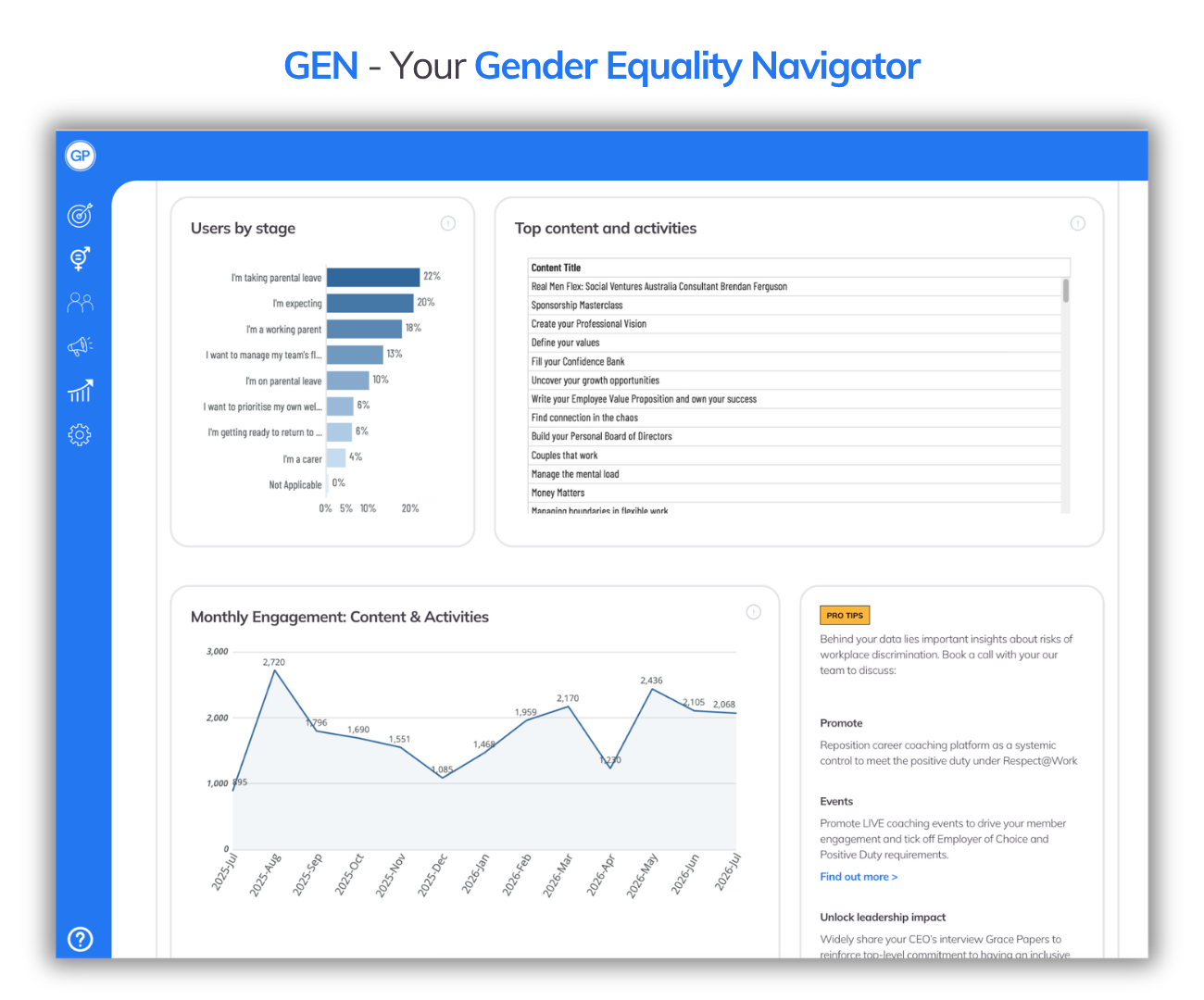
Your WGEA reporting shows where you were at a fixed point in time. GEN brings that together with the leading indicators collected through coaching, so you can see the direction of travel before it appears in your next WGEA report.
Your WGEA reported data mapped to the six indicators and tracked against your three targets from baseline. The lag indicator, held in one place
Live signals from coaching: Aggregated view of participation, confidence, agency and sentiment collected through sessions
Progress against each target, with the interventions and systemic controls intended to move it, ready for internal executive and governing body reporting, and to inform the commentary in your Employer Statement.
Transgrid reports unprecedented 50/50 of men and women taking primary care leave
Learn how Transgrid's balanced Primary Care options promote well-being and support for all, with more men than ever taking parental leave or accessing flexible work.